The law tends to favor the franchisor over the franchisee when it comes to breaking a franchise contract, primarily because franchisors are able to limit their liability via UFOCs and franchise agreements with built-in clauses and disclosures. It’s no wonder that franchisees have little wiggle room when opting out of an agreement: franchisors are required to list and substantiate earnings claims, current and past litigation, the number of franchises in operation and the number terminated, and all other related material in the UFOC/FDD document. Occasionally franchisors will provide a buyout clause to franchisees, but most franchisors want to preserve franchise agreements to save money and time. Hence, franchisors generally make every attempt to reconcile problems via arbitration or mediation.
Month: May 2008
How Much Can You Make in Franchising?
Franchisors often don’t give straight answers to franchisees asking the question “How Much Can You Make in Franchising?†due to the numerous legalities involved. To go into detail: the Federal Trade Commission (FTC) has strict requirements regarding earnings claims statements for franchisees. In a franchisor’s Uniform Franchise Offering Circular/FDD, earnings claims statements must be accurate and substantiated in written form. Franchisors can get into a lot of legal trouble if they misrepresent themselves in their UFOCs/FDDs.
Europeans just made a new usage of this tool created in the 4th millenium BC, the wheel. It’s hard to explain what Magic Wheel really is. I guess it’s easier to just watch this video and visit the company’s website.
Wallet Cards in Your iPhone
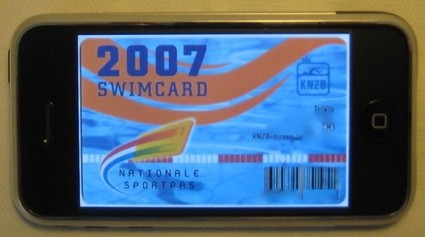
Enough of all these membership cards for the grocery store, the gym, or other retailers! Some smart dude came up with a simple, yet brilliant idea. He scanned all his memberships cards and synced them over to his iPhone.
To test it out I went to the local hardware store and asked the girl behind the counter if she could scan the barcode from my phone. The first look I got was pure amazement. To her the physical card was transformed into a picture on a shiny device. On top of that the barcode was scanned successfully. The result; a slightly confused girl and a happy me.
It obviously works fine. I’ve always wanted to try this with my airline boarding pass. Maybe I should give it a try next time I fly.
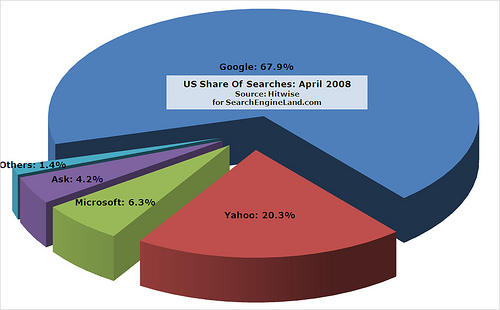
Hitwise released its latest April report and (surprise) Google has again hit a new high with 67.9% of all searches. Yahoo is second with 20.3% and Microsoft is far behind with only 6.3%.
Patricia Hursh wrote a good blog entry at SearchEngineLand.com about online registrations and downloadable asssets. Online efforts are designed to generate leads and a good way to generate those leads is to give an incentive to people to enter their contact information. Most of the time, the incentive will be a downloadable eBook, or white paper, or report; call it whatever you want.
Patricia presents 3 proven method to increase registrations:
- bundle information – you may want to mix what you’re offering. It can be a white paper plus the recording of a webinar. Or a report with a podcast. By doing so, you create a much higher perceived value.
- offer multiple media formats – you want to leave people the choice to either read, watch, or listen. Various formats can be, video clip, podcast, webcast, product demo or a simple text document.
- test names and descriptions – you can improve response rate by testing names and descriptions. By doing so, you might find out that “product demo” generates much more registrations than “virtual tour”
An article published today in Swiss newspaper Le Matin suggests that iPhone 2nd Generation will soon be available in Switzerland and will have cool features such as 3G, GPS (this is no news), but also Mobile TV and 2-way video chat.
The phone is also supposed to come with a more powerful processor. Now my question is “what about batteries life?”
MySpace has won a $234 million judgment over junk messages sent to its members in what is believed to be the largest anti-spam award ever, The Associated Press has learned.
A federal judge ruled against two of the Internet’s most prominent spam defendants, Sanford Wallace and Walter Rines, after the two failed to show up at a court hearing.
Rines and Wallace worked in concert to create their own MySpace accounts or take over existing ones by stealing passwords.
They then e-mailed other MySpace members asking them to check out a cool video or another cool site. When you go there, they were making money trying to sell you something or making money based on hits or trying to sell ring tones.
It would be a surprise, though, if MySpace ever collected. The giant judgments are all defaults, which means they don’t necessarily even know how to find the spammer.
There was no telephone listing for Wallace in the Las Vegas area, where he is last known to live. Service was disconnected for two listed numbers for Rines in Stratham, N.H., his last known address; a third number was unlisted.
A few weeks after being sued by eBay, CraigsList is now suing the auction giant, alleging eBay had used its minority stake in Craigslist to steal corporate trade secrets.
Craigslist’s complaint alleges a plan by eBay to use its position as a minority shareholder in Craigslist and its position on the Craigslist board to gather competitive information that led to the launch of eBay’s rival classifieds business. The suit claims eBay code-named Kijiji its “Craigslist killer” in internal strategy discussions.
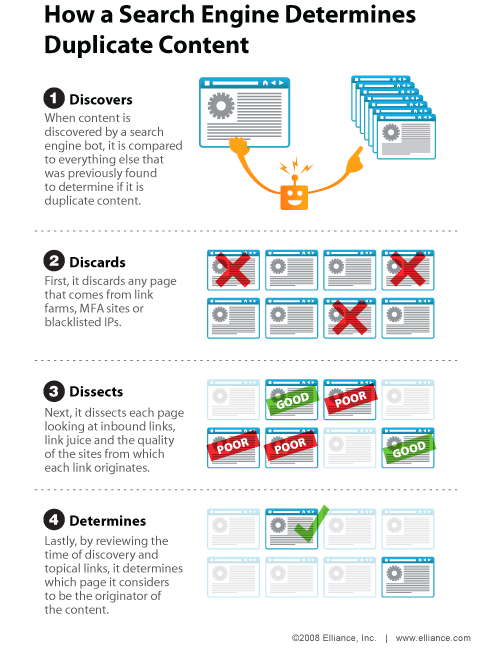
A good post over at SearchEngineLand.com shows how search engines determine duplicate content.