Categories
News Tech

Operate your computer by power of thought

Russian scientists won a $750,000 award for the development of the systems of the mental computer control. For the next 18 months they are going to develop programs and make a research that will help them to create such a system.

brainscan

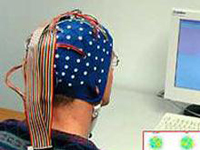
How does that work? Special equipment catches brain signals that go through the metal helmet with electrodes. Then with the help of a signal enhancer the signal will go to the computer.

This will make the life of disabled people much easier. Those who can’t move will be able to write email letters and even IM people around the world.

Categories
Business Franchising Internet

The multi-billion dollar online pizza order business

In the past seven years, Papa John’s has made a lot of dough from online ordering — more than $1 billion to be exact.

Other chains in the fiercely competitive pizza industry are tapping into the technology craze to give customers ways to order pies other than through the standard phone call or trip to a restaurant.

Dominos Pizza put its own twist on online ordering early this year by introducing a “Pizza Tracker,” which lets customers keep tabs on the progress of their orders. Consumers can find out when their pies are in the oven, when they’re on the way, and even the first name of their delivery person.

Pizza Hut, the nation’s biggest pizza chain, also allows customers to order via text messaging and mobile Web. The unit of Yum Brands Inc. soon will unveil a new method for ordering pizzas, dubbed “Pizza Hut Shortcut,” that it says will be the fastest in the industry. Customers will be able to download a “widget” onto their computers that will let them place their favorite pizza orders with just one click.

Categories
Internet

Intwition: tracking links on Twitter

intwitionIntwition tracks what people are linking to and talking about on Twitter. The site allows you to enter any domain, and will generate a report on which pages in that domain have been linked to, how many times, and by whom. It works by scanning Twitter’s public feed for posts with links, while resolving any shortened urls (such as tinyurl). What to do with Intwition? Find whose twittering about your website!

Categories
Internet

What people see (and don’t see) on a webpage

The truth is people don’t read very much, often scanning text instead of really reading it. On the average Web page, users have time to read at most 28% of the words during an average visit; 20% is more likely. This is at least what recent eyetracking studies showed.

In the study, the authors instrumented 25 users’ browsers and recorded extended information about everything they did as they went about their normal Web activities.

Among other things, the authors found that the Back button is now only the 3rd most-used feature on the Web. Clicking hypertext links remains the most-used feature, but clicking buttons (on the page) has now overtaken Back to become the second-most used feature. The reason for this change is the increased prevalence of applications and feature-rich Web pages that require users to click page buttons to access their functionality.

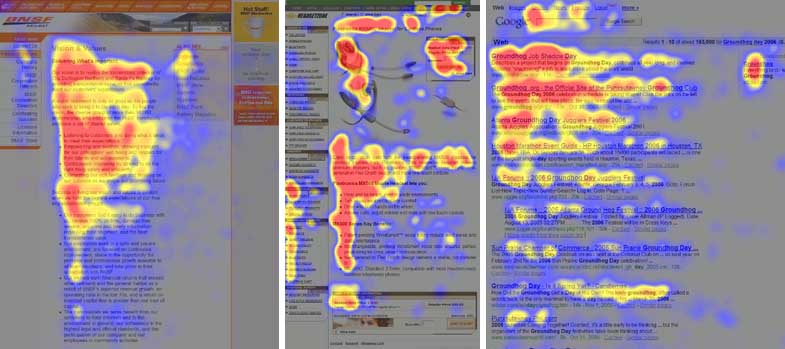
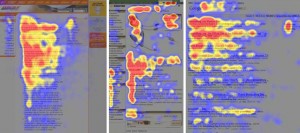
So, what do people really see on a page? Eyetracking visualizations show that users often read Web pages in an F-shaped pattern: two horizontal stripes followed by a vertical stripe.
reading pattern eyetracking

Users first read in a horizontal movement, usually across the upper part of the content area. This initial element forms the F’s top bar.

Next, users move down the page a bit and then read across in a second horizontal movement that typically covers a shorter area than the previous movement. This additional element forms the F’s lower bar.

Finally, users scan the content’s left side in a vertical movement. Sometimes this is a fairly slow and systematic scan that appears as a solid stripe on an eyetracking heatmap. Other times users move faster, creating a spottier heatmap. This last element forms the F’s stem.

Click here for full results survey results about the F-shaped pattern.

Other interesting results:

Banner ad blindness: Users rarely look at display advertisements on websites. Of the four design elements that do attract a few ad fixations, one is unethical and reduces the value of advertising networks.

Fancy formatting is ignored: One site did most things right, but still had a miserable 14% success rate for its most important task. The reason? Users ignored a key area because it resembled a promotion.

Numbers are better then letter: It’s better to use “23” than “twenty-three” to catch users’ eyes when they scan Web pages for facts, according to eyetracking data.

Talking heads are boring: Eyetracking data show that users are easily distracted when watching video on websites, especially when the video shows a talking head and is optimized for broadcast rather than online viewing.

Categories
Business iPhone

Sprint’s $100 Million Anti-iPhone Ad Campaign… Stupid!

Sprint is launching a $100 million advertising campaign for the Sprint Instinct, their attempt at an iPhone competitor. Gizmodo has two of the spots, and I suggest you watch them.

The ads put the Instinct and iPhone side by side for comparison, with overly-loud and abrasive music and narration. It looks like they tried to make them amusing, but they failed rather miserably.

Sprint is spending $100 million on pointing out the Instinct’s faster network and GPS-integration, while the iPhone will have at least 3G, and most likely GPS as well, in a few weeks.

Does Sprint have a VP of Marketing?

Categories
Business Internet

Microsoft feeling FaceBook!

Microsoft gauged Facebook’s interest in a possible acquisition after the software giant’s failed takeover attempt of Yahoo, the Wall Street Journal reported today.

The newspaper reported on its Web site that Microsoft’s bankers put out subtle signals to Facebook, the social networking Web site, to see if it would be open to a full acquisition.

Categories
Art

Obey Street Action In NY

Check out Shepard Fairey’s blog for some pictures of its artwork spotted in NYC.

Obey

Categories
Franchising

Aid That Franchisors Provide to Franchisees

Franchisors typically provide lots of aid to their franchisees, including the following:

Training/Operations manual:

Franchisors provide their franchisees with a detailed operations manual that contains instructions for carrying out their operating system. The operations manual lists the rules, standards and specifications of the franchise as well as the specific responsibilities and tasks of the franchisor. Information such as performance/management standards, processes and protocol and employee roles is also contained in the manual. In addition to an operations manual, franchisors provide operating system and business training for franchisees. Training can take place at any location designated by the franchisor, including corporate headquarters.

Categories
Franchising

Rob Bond in Franchise Times

After being profiled in the March issue of Franchise Times, it’s now my boss, Rob Bond, who is the franchise executive of the month in the current issue of this highly regarded magazine. As far as I can remember, it is the first time 2 people from the same company are profiled. Franchise Times surely loves us… Who doesn’t :-)

Check out Rob’s profile in Franchise Times

Categories
Internet iPhone

Top 10 Apps Download Websites

Looking for apps for Windows, OSX or Linux? Want to pimp your iPhone, Myspace or Facebook? Here is a selection of the top 10 resources: